
How to Search Criminal Dockets
The statewide public route to Seward County and District Court criminal cases is the JUSTICE One-Time Court Case Search. Start with a full party name. Too many matches? Narrow by Seward County, court type, criminal case type, or year. A case number works best. It leads straight to the matching case summary and Register of Actions. The paid one-time route returns up to 30 cases. It keeps results for three calendar days, and lags about 24 hours behind new entries.
Treat a name result carefully. A misspelling can change what shows up. So can a fresh filing, a restricted matter, or a case in the other court. The same records are free at a courthouse JUSTICE kiosk and at designated public law-library terminals. When an image will not appear or you need an official copy, the clerk is the practical path.
- Open JUSTICE and agree to its search terms before beginning the paid name-search route.
- Enter the full party name first, then add Seward County or the court and case-type filters only when they help separate results.
- Open the matching case summary and read its Register of Actions in chronological order, beginning with the most recent entry.
- Compare the current setting, charge information, and disposition fields instead of relying on one event line.
- Ask the appropriate clerk for a copy or certification when the online record is not enough.
The official JUSTICE search screen presents the agreement and the controls that start a Seward County criminal docket lookup.
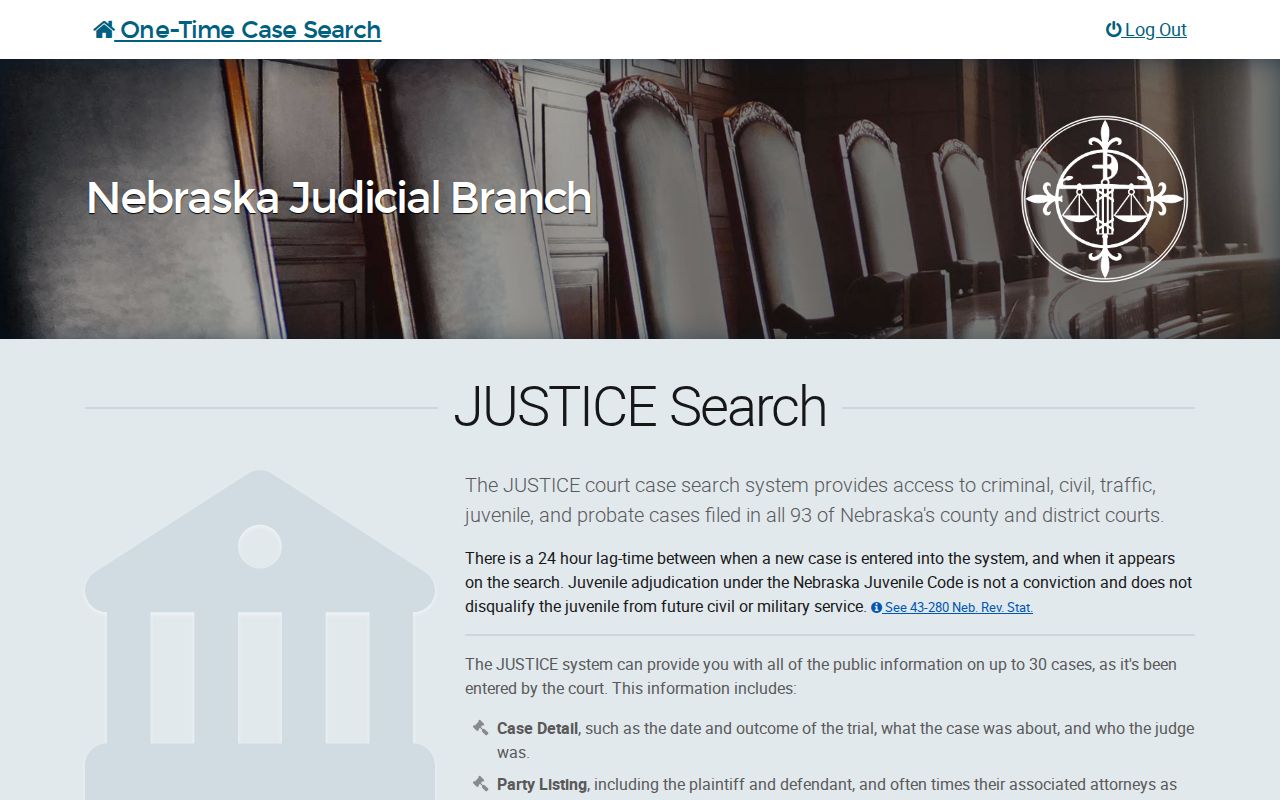
Work through the displayed controls to find the public case. Then check the result against the court and case type on the record itself.
JUSTICE Limits for Seward Criminal Searches
JUSTICE is a public case-information system. It is not a police-report archive and not an open e-filing account. Its detail view can show the case summary, parties, criminal-offense information, financial information, and the Register of Actions. It can also show court costs and judgments assessed or paid, payments, and any available document images. Images are generally described for documents filed or uploaded after April 16, 2008 when available. Nebraska.gov eFiling/eNotice serves authorized filing users. Its login cannot replace a public docket search.
The remote $17 name-search charge applies even when the search returns nothing. A blank result does not prove that no Seward criminal case exists. Rework the spelling and confirm the court selection. Allow for the 24-hour lag, and try the court terminal or the clerk if the matter must be found. Subscriber pricing and terms can shift. Confirm them on the Nebraska subscriber service before relying on that separate account.
Note: a public search result identifies a court record. The original order or certified copy stays with the clerk who keeps the case file.
What a Criminal Docket Shows
Nebraska names the event timeline a Register of Actions. In a Seward County criminal case, it chronologically lists filings, hearings, notices, orders, pleas, judgments, dispositions, and other events the court enters. The case summary gives the identifying context around that timeline. Field labels and the depth of detail vary from case to case, so read the actual entry rather than assuming a local abbreviation means the same thing in every file.
| Case header | Case number, court and county, case type or subtype, filing date, status or disposition when entered, and assigned judge where displayed. |
|---|---|
| Parties and charge data | Party names and roles, offense information, and statutory classification information when the system has it. Party-name searching is not a witness search. |
| Register of Actions | The dated sequence of filings, hearings, orders, notices, pleas, judgments, and other court events. |
| Setting details | Hearing date and time, courtroom or location, judge, caption, and setting type where the calendar or case view exposes them. |
| Financial information | Court costs, fines, restitution, judgments, and payments by or to the court when those fields are entered. |
| Outcome | The disposition or judgment and its date when entered. A closing label should be read with the underlying order. |
The Nebraska protected-information rules explain why a public criminal docket can list a case while leaving out personal data or a document image.
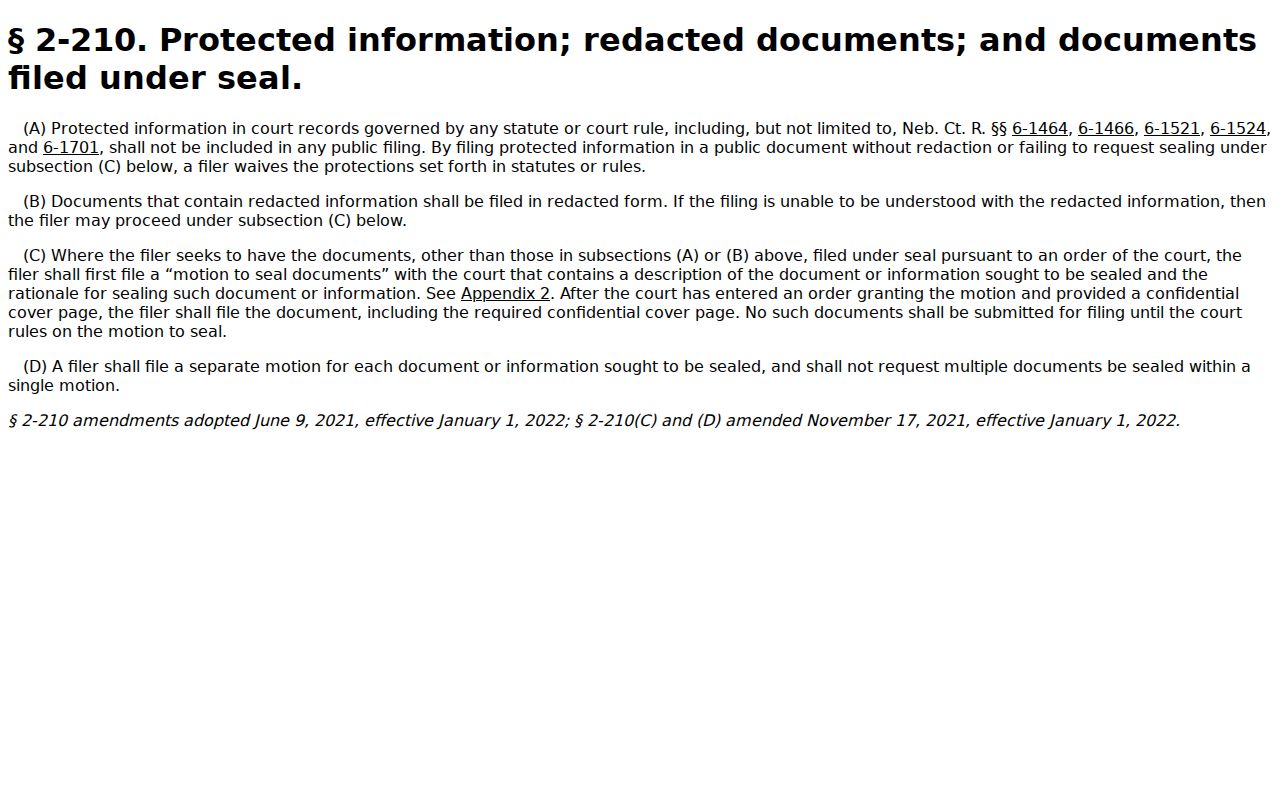
Redaction and restriction rules shape what the public sees. So read the Register of Actions as a case timeline, not a full copy of every filing.
118 Felony and 327 Misdemeanor Filings
Seward County Court's FY2025 report counted 118 felony filings and 327 misdemeanor filings. Those figures cover July 1, 2024 through June 30, 2025. They count filings only, not people, open cases, convictions, hearings, or records open to viewing. The report also listed 404 traffic filings separately. Traffic cases stay traffic cases; they do not turn into District Court felony dockets just because they are criminal-related court matters.
One case can generate many entries. A filing may later be transferred, dismissed, appealed, or sealed. The numbers describe the volume entering the County Court system; they say nothing about how an individual Seward County criminal docket will turn out.
Stages on a Criminal Docket
A criminal Register of Actions may open with a complaint or charge, then move through a warrant or summons, arraignment, plea, bond event, notice of setting, motion, hearing, order, judgment, and financial entries. No fixed sequence is promised. Some matters end early. A felony can start with County Court preliminary proceedings before moving to District Court. Read the latest event alongside the disposition field before deciding where a case stands.
Docket flow: Filing → Arraignment → Pretrial → Plea or Trial → Disposition → Sentencing
An arraignment marks a stage, not a conviction. A bond entry is not a final outcome either. A dismissal, likewise, can cover one charge or the whole case, and the order itself supplies the context. The Register records court events; it does not make every event the final result.
Seward Preliminary Hearings and Felony Transfer
Seward County Court takes care of misdemeanors, traffic matters, and the early stages of a felony case. That early stage is the preliminary hearing. It is a screening step where the judge decides whether the charge should move forward. If the felony is bound over, prosecution shifts to a Seward District Court docket in the Fifth Judicial District. So a felony in Seward County can leave a trail across two courts. The county register will not show what happens after the transfer.
The split matters for anyone doing a docket search. County Court holds the felony file only up to bind-over. Seward District Court holds the prosecution once it moves up. The Nebraska court-structure flowchart shows where both trial courts sit in the state system. It also names the Nebraska Court of Appeals as the intermediate appellate court. Appeals and a later district record never wipe out the county-level docket. It stays where it was filed.
Note: A transfer only reroutes a case between courts. To track it, watch the court name and the newest Register entry rather than a generic criminal-case label.
Which Court Holds Criminal Dockets
Seward County Court and Seward District Court both sit in the Fifth Judicial District. Yet each keeps its own criminal records. The County Court clerk runs county-level criminal operations. The District Clerk keeps district criminal files, dockets, judgments, writs, and orders. Costs, fines, restitution, and the papers are there too. The state County Court directory and the District Court directory list their separate contacts.
Need a felony file after bind-over or any district-level criminal record? For that, contact Sheila Lueders, Clerk of the District Court. Her office is Justice Center Suite 145, 261 S. 8th Street, Seward, NE 68434, 402-643-4895. For a misdemeanor, traffic, or preliminary-hearing file, start with the Seward County Court clerk. The state directory lists that clerk at 402-643-3214. Seward County’s own page still shows 402-643-3341. Call ahead to confirm the county number before relying on it for a deadline.
Seward Criminal Entries Are Not Convictions
A criminal docket can hold many kinds of entries. Entries include a charge, arraignment, bond, hearing, plea, dismissal, judgment, or payment. None of those labels stands alone. A charge is only an accusation entered in the court record, not a finding. A bond field covers release or security details when entered. The record’s outcome label is its disposition. What that means can hinge on an order, one specific charge, or a later filing. Read each entry inside the full case sequence.
- Arraignment
- A criminal appearance where charges, rights, and the plea process are addressed.
- Preliminary hearing
- The County Court proceeding used in a felony matter before a possible bind-over to District Court.
- Notice of setting
- An entry placing a case on a date or time; it is not itself the hearing result.
- Disposition
- The closing or outcome label and date entered by the court, which should be read with the relevant record.
To track a hearing, check the Seward County court calendar first. Then compare that result with the latest Register entry and what the right clerk tells you.
Public Access and Sealed Criminal Dockets
Nebraska electronic-access rules open party indexes, case summaries, Registers of Actions with available images, calendars, and judgment summaries to the public, with exclusions. Public display does not promise that every document or identifier appears. Criminal records suppress Social Security and tax-identification numbers. They also trim a birth date to the birth year, use initials for minors, and mask financial-account numbers. Victim forms marked confidential stay outside the public file.
Key Rules:
Nebraska Public Records Act, §84-712 provides for inspection of public records during working hours and a written-request response, estimate, or explanation within four business days.
Nebraska Court Rule §1-805 identifies case indexes, summaries, Registers of Actions, calendars, and judgment information that may be available electronically.
Nebraska County Court criminal redaction rules require protection of listed personal and financial information in public criminal records.
The official County Court redaction material shows why a Seward County criminal docket can be public yet hold back parts of a filing.
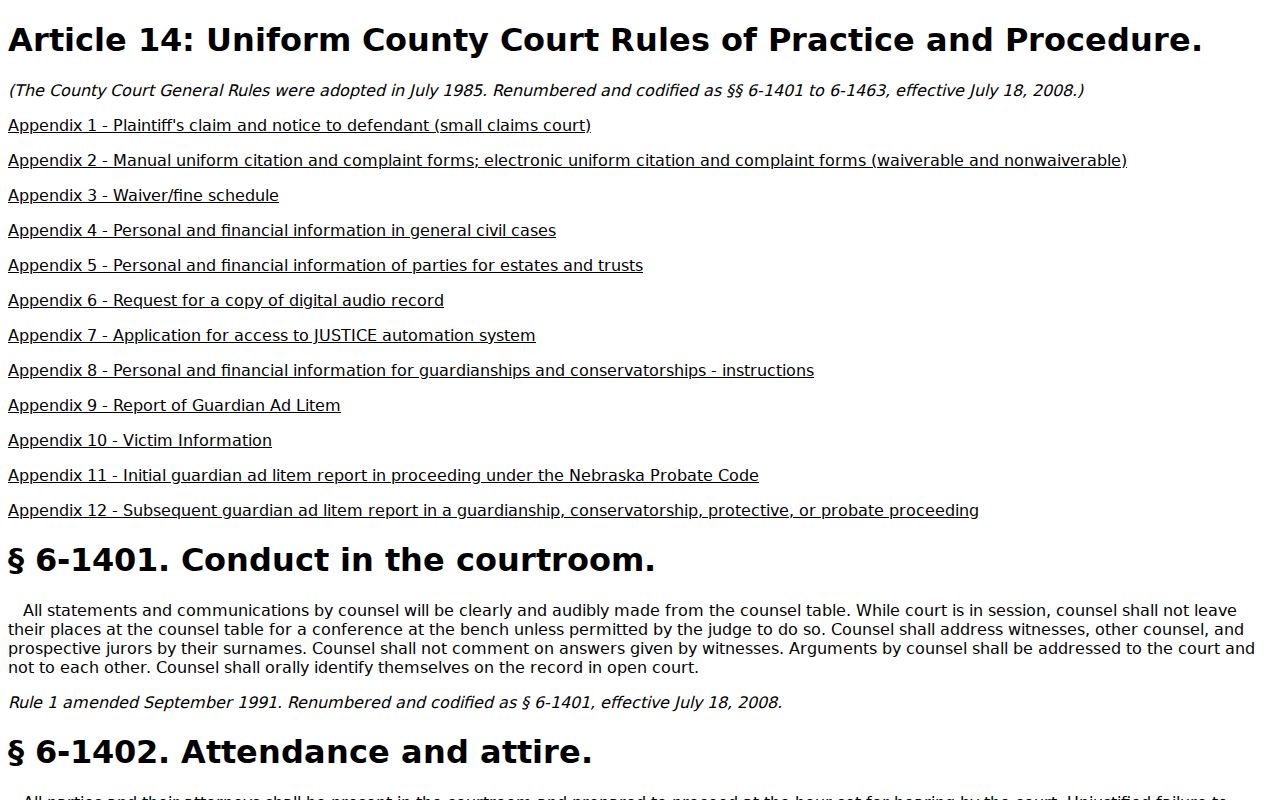
Sealed cases, confidential reports, and juvenile restrictions call for a clerk or court process. Do not try to rebuild withheld details from some other source.
Missing Seward Criminal Images and Copies
A Register entry can be visible while its image is not. Images hinge on filing date, upload, availability, redaction, sealing, and case-specific access limits. A blank image link does not mean nothing was filed. Check the court and case type. Give a new entry time to reach the public system. Ask the clerk whether the document is restricted, offline, or available through the normal copy process.
Need an official copy? Use Nebraska’s Request for File Copies or Certified Copies form CC 3:29. List the court, county, case number, case name, the document and its date. Add your delivery choice and whether you need certification. A screen view is not a certified copy. Courts also will not issue a certificate stating that a search turned up no record.
The District Court criminal redaction rules cover one more thing. They govern the district-file counterpart to a Seward County criminal docket.
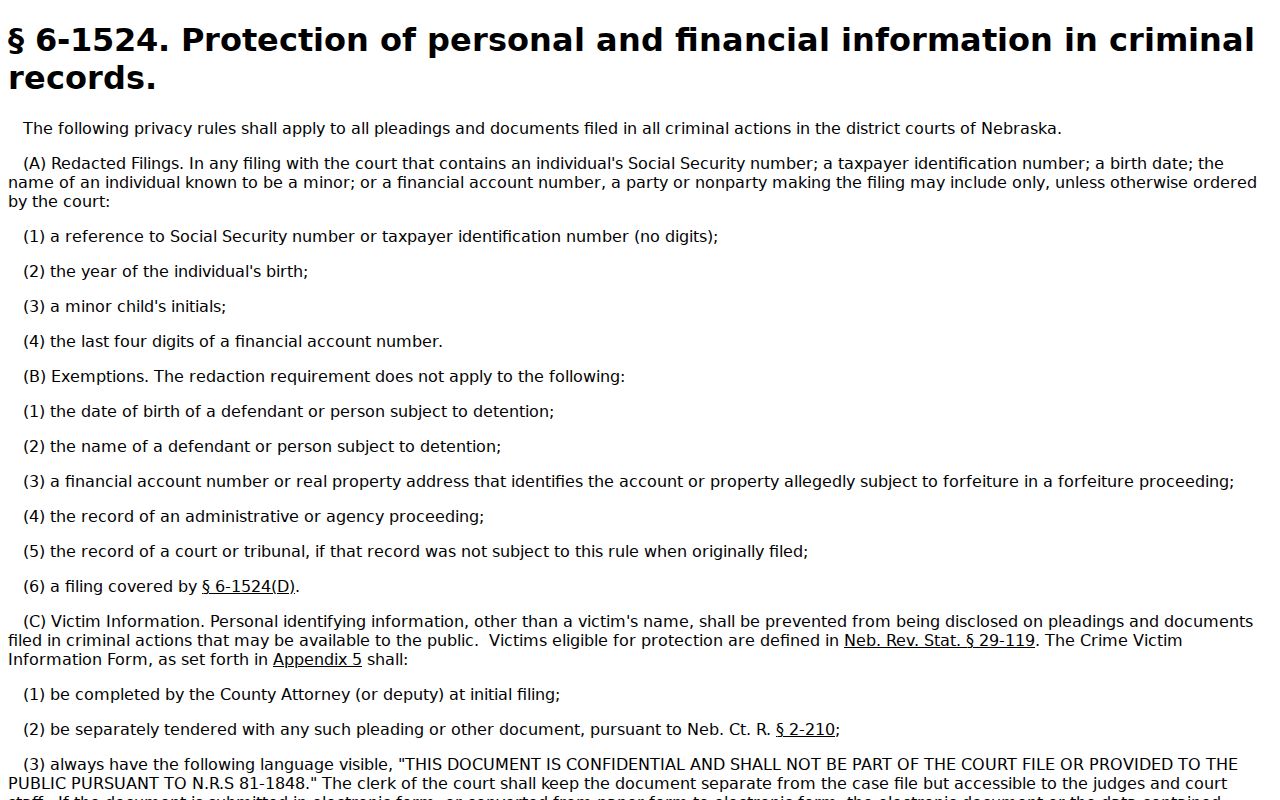
When a document truly matters, ask the clerk who holds it for the record. That clerk can tell you which public, certified, or restricted-copy path applies.